Fairbanks Weather and Climate
You have reached my Fairbanks weather page. Here you will find several weather graphs generated using data I collect from various public sources, including Mesonet, the Citizen Weather Observer Program, the National Weather Service, Weather Underground, and the Department of Defense. Some of the data is pulled directly from the website reporting the data, and the rest comes from the Meterological Assimilation Data Ingestion System (MADIS).
Temperature, dew point, barometric pressure, and wind over the last seven days
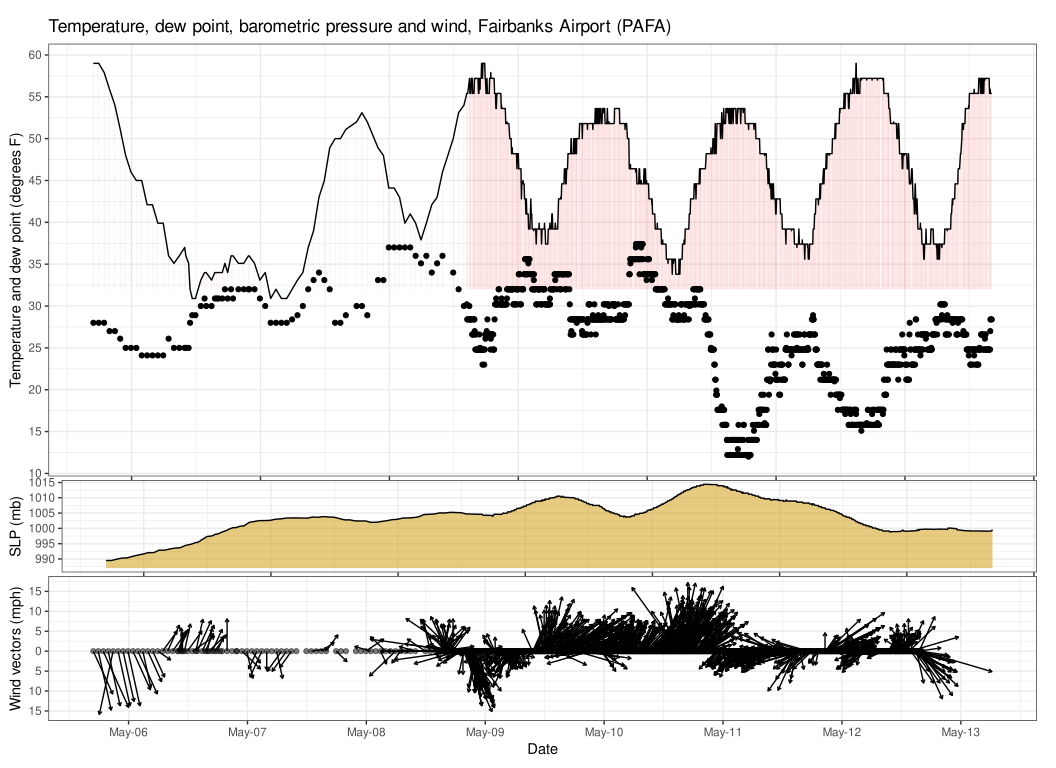
Plot updated 2024-04-27 02:23:03
The top facet shows temperaure (the blue region) and dew point (the black circles). The closer the temperature is to the dew point, the higher the relative humidity. The middle facet shows barometric pressure. Higher numbers indicate greater pressure, and generally mean better weather. The bottom shows wind vectors where the length of the arrow is the wind speed and the direction the wind is blowing is indicated by the direction of the arrow. For example, an arrow pointing straight down is a “north wind” because it originates from the north.
Other pages:
Goldstream Creek Data: We have a station at our house on Goldstream Creek, and a variety of data is available from the station page.
Hourly Data
- Current conditions for the Middle Tanana Valley, all reporting stations (table)
- Current conditions for the Middle Tanana Valley, all reporting stations (map)
- Plot of all Fairbanks area station data, last three days
- Temperature, pressure and winds at the Fairbanks airport
Daily Data, Last 90 days
- Ninety day summary (temperature, precipitation, snowfall)
- Ninety day temperature anomaly (daily mean vs. 30 year average mean temperature)
- Ninety day cloud cover
Daily Data, Last year, 90 day plots
- Ninety day summary, last year (temperature, precipitation, snowfall)
- Ninety day temperature anomaly, last year (daily mean vs. 30 year average mean temperature)
Daily Data, Last 180 days
- 180 day summary (temperature, precipitation, snowfall)
- 180 day temperature anomaly (daily mean vs. 30 year average mean temperature)
Daily Data, Last 365 days
- Yearly summary (temperature, precipitation, snowfall)
- Yearly temperature anomaly (daily mean vs. 30 year average mean temperature)
Daily Data, Cumulative graphs
- Cumulative precipitation so far this month
- Cumulative snowfall, month to date
- Cumulative snowfall since July 1
- Cumulative precipitation anomaly, year to date
- Cumulative heating degree days since July 1
- Cumulative cooling degree days since June 1
Daily Data, Yearly summaries
- Temperature anomaly heatmap since 2002
- Temperature anomaly heatmap for the last 12 months
- Normalized temperature anomaly heatmap since 2002
- Normalized temperature anomaly heatmap for the last 12 months
- Summary for 2006 (temperature, precipitation, snowfall, cloud cover)
- Summary for 2005 (temperature, precipitation, snowfall, cloud cover)
- Summary for 2004 (temperature, precipitation, snowfall, cloud cover)
- Summary for 2003 (temperature, precipitation, snowfall, cloud cover)
- Summary for 2002 (temperature, precipitation, snowfall)
- Summary for 2001 (temperature, precipitation, snowfall)
- Summary for 2000 (temperature, precipitation, snowfall)
- Summary for 1999 (temperature, precipitation, snowfall)
- Summary for 1998 (temperature, precipitation, snowfall)
Sunrise and sunset times for Fairbanks
Data collection is performed using Perl and Python scripts that download, parse and stores the data locally. gnuplot and R (with ggplot2) generates the majority of the plots on these pages.
As of October 2008, we have a continuously reporting weather station at our house on Goldstream Creek. It's an interesting place because it is at the bottom of the valley, and so it's temperatures can be much colder than in the rest of Fairbanks. Information on the station, the data collection methods, data and plots are available at the Goldstream Creek Station pages.
Important disclaimer: My data providers and I disclaim liability of any kind whatsoever, including, without limitation, liability for quality, performance, merchantability and fitness for a particular purpose arising out of the use or inability to use the data. This disclaimer applies to all pages at swingleydev.com.